How “aperture” plays a role in exposure

In my last post I talked about setting a foundation, by first learning about the important aspects of your camera’s controls; aperture, shutter speed, and iso which are the settings that control exposure. “Exposure” is simply the brightness of the photo captured. However, we need to learn about these three controls individually before we can completely understand exposure.

Your camera records light. “Aperture” is simply the diameter of a “hole” in the camera’s lens, that you can control , which determines the amount of light that reaches the camera’s sensor (a component in the camera that records the image).
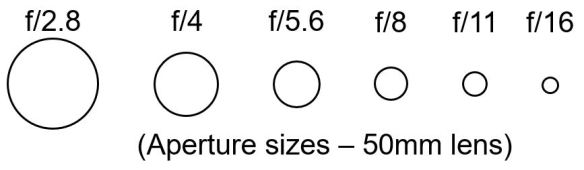
Aperture sizes 50mm

In the diagram above, notice that “Aperture” is shown in the form of “f/n” where “n” represents the aperture setting on your camera (example; 2.8, 4, 5.6 etc…). Also notice that the lower the aperture setting, the larger the hole. This is because “f/n” represents the inverse of the aperture setting. For example if we take 50/2.8 = 17.9 we see it is a larger number than 50/4 = 12.5.

The “Aperture” setting is referred to as an f-stop meaning full stop. The diagram above shows aperture settings in full stop values. Notice the size of the hole at f/4 is half the size, or half the amount of light, of the hole at f/2.8 and f/5.6 would be half the amount of light of the hole at f/4 reaching the camera sensor etc… Also consider that the amount of light at f/4 is double the amount of light at f/5.6, because the size of the hole at f/4 is double the size of the hole at f/5.6.

For the above discussion think of the amount of light let into the camera by the aperture setting is one of the controls that has an effect on the brightness of your photo.

In the next article we will uncover the creative control behind aperture.
What is “You Can Learn Photography” all about?

Introduction_2016-08-12_MG_8385I know there are many photography training web sites out there, but there are also many beginner to intermediate photographers who really just want to get to making better images right away.

By first learning the basics it establishes a solid foundation so you can move up to actually creating better images. The intention behind “You Can Learn Photography” is to help you by sharing what I wish I knew when I first started in Photography.

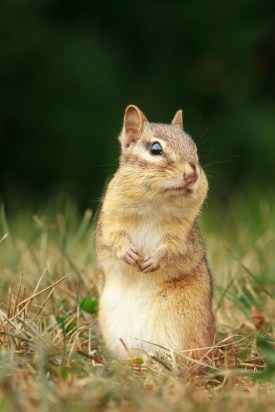
Some of us get into Photography because it’s a form of relaxation that gives us internal joy to help us recover from some life changing event or a hobby we turn to giving us some form of stress relief. Like getting close and intimate to this chipmunk, along the journey we realize what we have been missing as we discover things we had never really noticed before, as we become more appreciative of mother nature feeling excited about the new discoveries we experience each new day brings.

As we look at our pictures we realize that they do not show what we saw or felt and just hope as we take more and more pictures that magically they will eventually get better. Yes it does take practice but we soon discover we need to learn many things to get there. So we start seeking out information through searching online, watching YouTube, reading magazines, looking at our camera manual, and realize it’s overwhelming all the time asking ourselves why is it so hard to create good looking images.

It’s like learning anything, like how to play baseball, ride a bike, or drive a car we need to know some things that need to become second nature so we can actually get down to the business of not just taking pictures but creating images.

My formula for making a good image requires; a good Exposure, Creative technique, good Composition, interesting Subject(s), a decisive Moment, and Light.

To help you get there, I will take you on a journey starting with the camera settings to help you get to a good exposure, this is creating a solid foundation for your photography by knowing your camera. We will break down aperture, shutter speed, and ISO so that you can understand not only how to get a good exposure but also the creative aspects with the setting choices you make. This is like learning the rules of the road before you actually get to drive a car.

We will go on a journey together through many blog articles to come. I will help get you to a point where you are comfortable with your camera, camera settings, and compositional guidelines, to where you are not just taking pictures but making better images.

If you are new to the Blog please start with the “Articles” page which is basically a Table of Contents for the Blog Posts on learning photography.

Keep an eye out for the “Explore Life” Fall 2019 program for our next time frame to offer the Introduction to Digital Photography course.

If you are looking for detailed information on any of our course offerings please visit our courses page.